SunTera G2
5.01MWh IEC
5.01MWh IEC
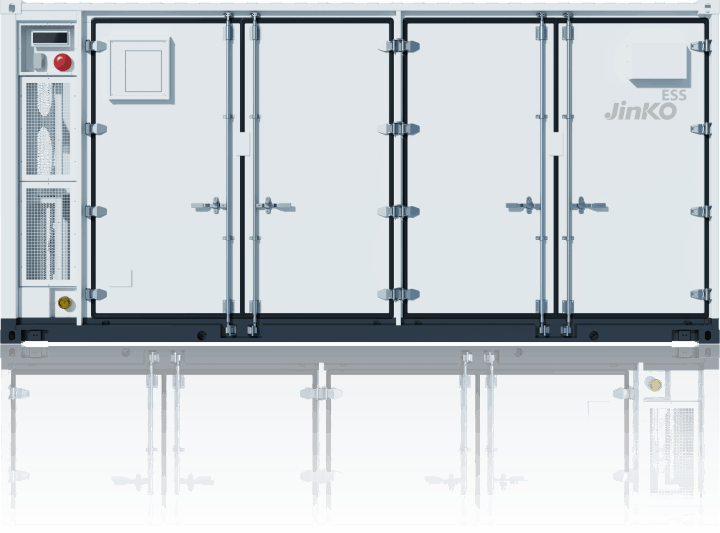
The Jinko 5.01MWh liquid-cooled ESS integrates 314Ah LFP cells, advanced thermal management with 20% lower auxiliary power consumption, and intelligent O&M for reliable, safe, and cost-effective grid-scale energy storage.
Key Advantages

Refined flow channels keep cell temperature differentials within ≤2°C, while multiple cooling modes reduce auxiliary power by 20%
≤2°C
Cell Temperature Differential
↓ 20%
Aux. Power Reduction
- Cell Temperature Differential: ≤2°C
- Aux. Power Reduction: ↓ 20%

Rack-level management boosts RTE by >2%, while active balancing improves cell consistency
≥94% (0.5P)
≥95% (0.25P)
≥95% (0.25P)
DC RTE
↑>1%
Usable Energy
-
DC RTE: ≥94% (0.5P)
≥95% (0.25P) - Usable Energy: ↑>1%

Five-level cell-to-system protection helps prevent thermal runaway, with integrated gas and water fire suppression
5-tier
Protection Architecture
EN1364-1
Fire Suppression
Battery/HV
physically isolated
physically isolated
Cabin Design
UL9540A 2026
Certifications
- Protection Architecture: 5-tier
- Fire Suppression: EN1364-1
-
Cabin Design: Battery/HV
physically isolated - Certifications: UL9540A 2026

Intelligent control simplifies commissioning and reduces O&M costs. Flexible placement maximizes site energy density.
≤30 min
OTA Upgrade Time
<1s
Remote O&M Latency
Leak-free swap
+ front access
+ front access
Maintenance
- OTA Upgrade Time: ≤30 min
- Remote O&M Latency: <1s
-
Maintenance: Leak-free swap
+ front access
Applications
Generation-side
Stabilize and optimize renewable energy output
while supporting grid stability.
while supporting grid stability.
Stabilize and optimize renewable energy output
while supporting grid stability.
while supporting grid stability.
Grid-side
Support grid dispatch for peak shaving and frequency regulation,
improving system flexibility and stability.
improving system flexibility and stability.
Support grid dispatch for peak shaving and frequency regulation,
improving system flexibility and stability.
improving system flexibility and stability.
User-side
Reduce grid load, meet diverse energy needs,
and improve power supply reliability for end users.
and improve power supply reliability for end users.
Reduce grid load, meet diverse energy needs,
and improve power supply reliability for end users.
and improve power supply reliability for end users.

Follow us